IN OUR LATEST INSIGHTS PIECE, WE EMBARK ON A JOURNEY TO UNRAVEL THE INTRICATE WEB OF VALUE CHAIN COLLABORATION, WITH A FOCUS ON PRICE AND COST TRANSPARENCY.
IN OUR LATEST INSIGHTS PIECE, WE EMBARK ON A JOURNEY TO UNRAVEL THE INTRICATE WEB OF VALUE CHAIN COLLABORATION, WITH A FOCUS ON PRICE AND COST TRANSPARENCY.
In today’s dynamic business landscape, where supply chains form the lifeblood of organisations, it has become increasingly crucial to explore how collaboration can bolster the visibility and resilience of these vital networks.
#4 AIM FOR PRICE AND COST TRANSPARENCY.
Buying and procurement professionals, along with category owners, face an evolving role where they are increasingly expected to understand the underlying cost drivers of their product categories, as opposed to simply negotiating a buy-sell price. This necessitates a deeper comprehension of the intricate interplay between cost elements and selling prices and how these are built up. This transformation is being propelled by market dynamics, most notably the proliferation of private label brands across various regions. Organisations are fiercely vying for a slice of consumers’ wallets, driven by the clear preference of today’s consumers for products that combine competitive pricing with superior quality and impeccable traceability.
To meet these demands, category and product owners must develop a more profound understanding of the entire value chain, comprehending how product costs and attributes evolve from the source to the final product. Unfortunately, a clear and comprehensive cost breakdown, including components such as raw materials, waste, conversion, labour and added margins, is often elusive or misunderstood. Most often, final cost prices are not linked clearly to the underlying commodity price and associated drivers, resulting in incorrect decision-making due to the lag which exists between the cost price and underlying cost drivers.
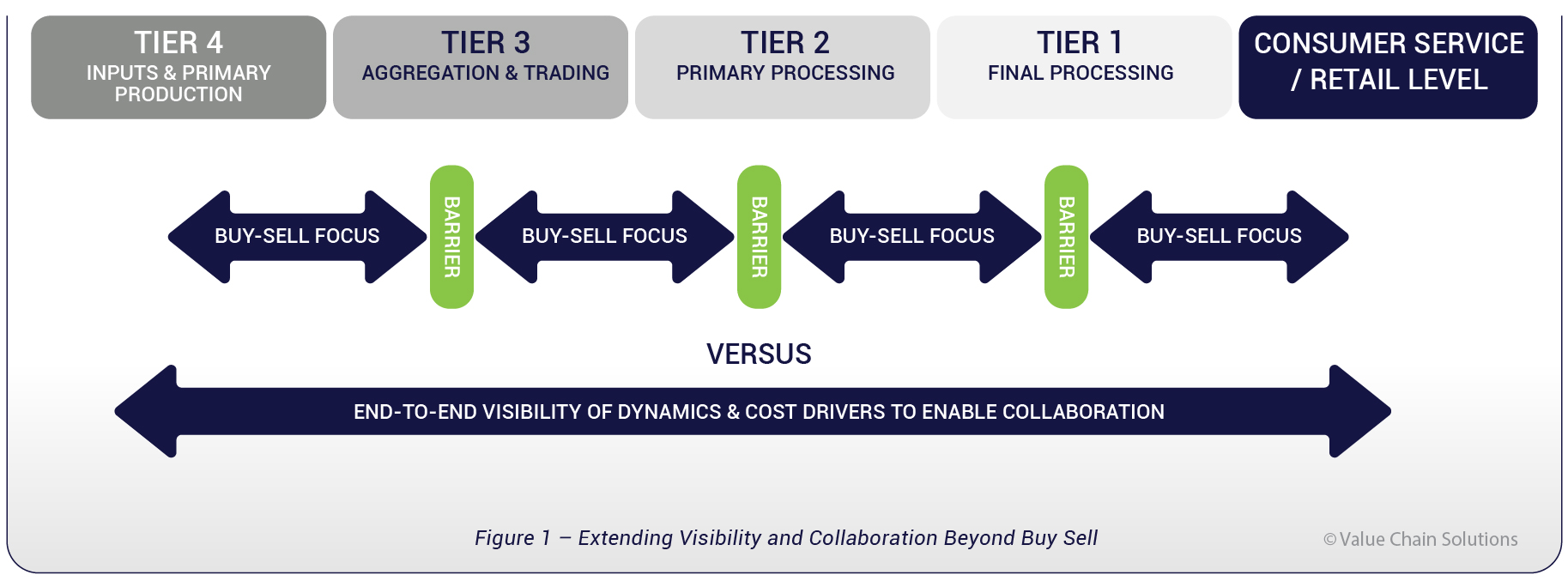
Figure 1 provides a glimpse into a typical value chain. It underscores the imperative to broaden our understanding beyond the confines of typical buy-sell relationships, which traditionally focus solely on cost prices.
Indeed, as shown in the example, this limited visibility into cost structures is a common challenge in price planning, promotions and product optimisation functions. Decision-makers typically only have access to their immediate suppliers’ cost prices, lacking a com prehensive understanding of the intricate factors that shape these prices. This restricted insight hinders proactive decision-making and often results in overlooking critical cost driver fluctuations until they become pressing issues.
Consider the real-world example of the wheat-to-wheat flour supply chain, a crucial link in the production of baked goods. This scenario exemplifies the pressing need for transparency in pricing and cost structures within value chains, a topic of paramount importance for effective marketing and decision-making.
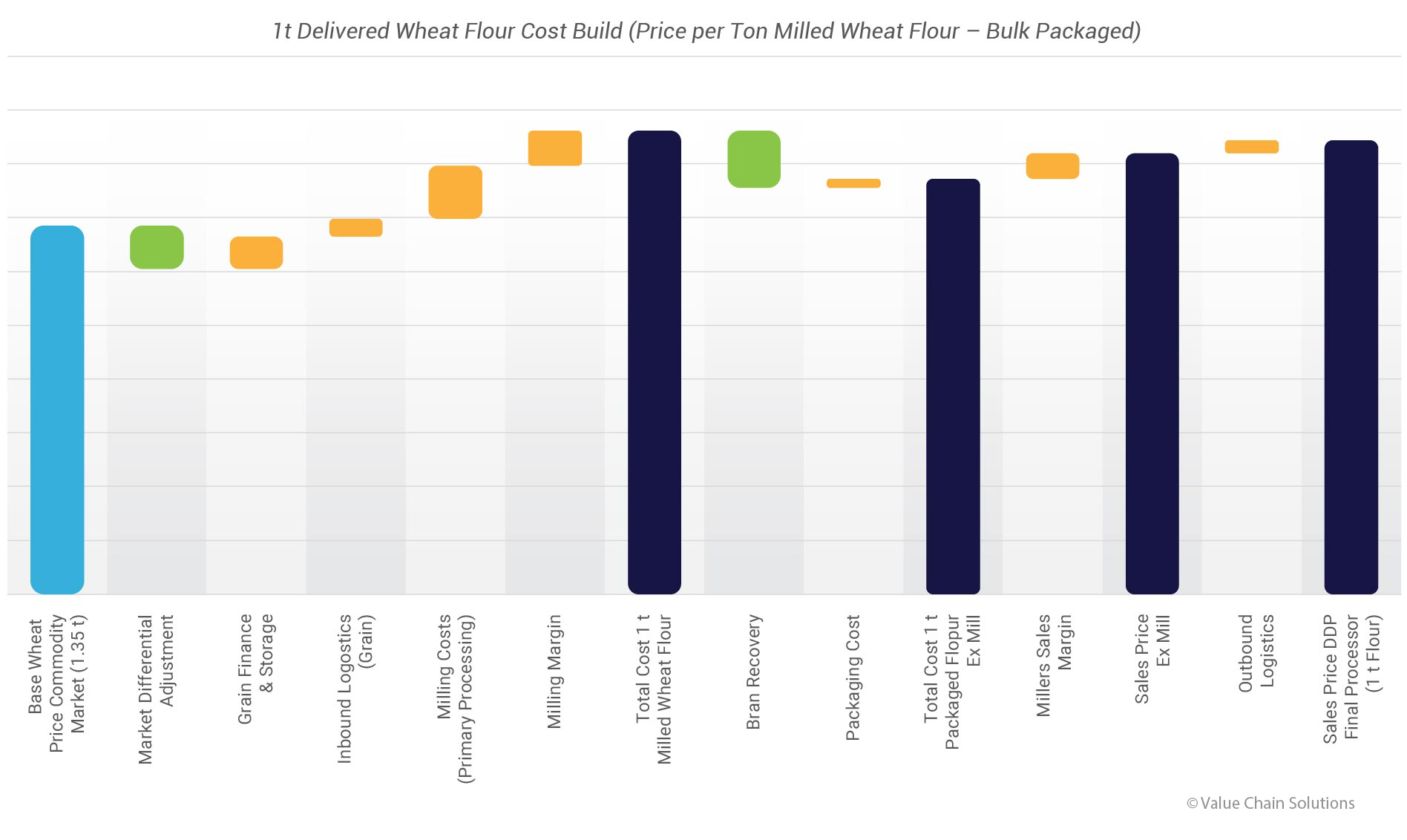
In Figure 2, we present a simplified cost breakdown of the journey from wheat grain to wheat flour within this chain. Here, we shed light on a common challenge faced by retailers and final processors. These retailers receive finished products containing wheat flour from their suppliers, the final processors. However, both the retailers and final processors often lack a comprehensive understanding of the cost components driving price fluctuations – for example the cost make-up of wheat flour as an ingredient or finished product. This lack of transparency can prove to be a significant hurdle when setting prices for consumers. Incorrect pricing decisions can lead to not only financial losses but also reduced volumes and margins.
Likewise, the final processors, who rely on millers for their supply of flour, confront a similar issue. They, too, often lack clarity regarding pricing and cost dynamics. Specifically, they may struggle to discern the impact of fluctuations in commodity prices, such as wheat grain, on the overall cost structure. Without this insight, they might miscalculate the costs associated with their final products, creating a ripple effect throughout the value chain.
Now, consider a global commodity shock, like the one caused by the war in Ukraine. This event sent shockwaves through various global commodity markets, including wheat grain. Primary processors, final processors and retailers found themselves in a state of uncertainty. They lacked the foresight to understand how the surge in wheat grain prices would affect the costs of their respective products. In response, many adopted reactive strategies, which ultimately proved detrimental to the end consumers of wheat-containing finished goods. As prices fluctuated, all participants including consumers in the value chain experienced the crunch, often resulting in decreased volumes and adverse effects on their businesses.
Figure 2 – Typical End-to-End View of Cost Build Dynamics from Commodity to Final Product
This real-world example underscores the critical importance of price and cost transparency within value chains. With greater visibility into the cost elements and dynamics at play, businesses can make informed decisions, mitigate risks and better serve their customers while ensuring the sustainability and profitability of the entire value chain.
In recent years, the market landscape has undergone a transformative shift, driven by consumer demand for cost-effective, quality-focused products. This shift in consumer preferences has forced industry players across the value chain to reevaluate their strategies and adapt to a new paradigm. The competitive landscape today is characterised by a relentless pursuit of value, where cost-effectiveness and product quality are the twin pillars upon which success is built.
It is abundantly clear that those who can effectively collaborate across the value chain will have a distinct advantage in this evolving market. The traditional buyer-seller relationships, with their inherent high transactional costs, are increasingly becoming unsustainable in this dynamic environment. To thrive, businesses must embrace a new era of collaboration at scale across the value chain.
The foundation of successful collaboration lies in transparency – transparency in pricing, cost structures and supply chain dynamics. By sharing vital information, value chain participants can optimise their operations, streamline processes and ensure that cost-effective, quality-focused products reach consumers efficiently.
In essence, the call for cost and price transparency is not merely a response to market trends, it is a strategic imperative. It empowers businesses to navigate the shifting competitive landscape, deliver superior products and achieve sustainable growth. As we move forward, those who embrace transparency and forge strong collaborative bonds within their value chain partners will not only meet consumer expectations but also thrive in an era defined by cost-effectiveness and quality.
IN OUR NEXT AND FINAL INSIGHTS PIECE IN THIS SERIES, WE WILL TAKE A CLOSER LOOK AT HOW TO LEVERAGE TECHNOLOGY AND VALUE CHAIN DATA TO DRIVE FACT-BASED COLLABORATION.
We use cookies on our website to give you the most relevant experience by remembering your preferences and repeat visits. By clicking “Accept All”, you consent to the use of ALL the cookies. However, you may visit "Cookie Settings" to provide a controlled consent. Click here to read our Privacy Policy.
This website uses cookies to improve your experience while you navigate through the website. Out of these, the cookies that are categorized as necessary are stored on your browser as they are essential for the working of basic functionalities of the website. We also use third-party cookies that help us analyze and understand how you use this website. These cookies will be stored in your browser only with your consent. You also have the option to opt-out of these cookies. But opting out of some of these cookies may affect your browsing experience.
Necessary cookies are absolutely essential for the website to function properly. These cookies ensure basic functionalities and security features of the website, anonymously.
Cookie
Duration
Description
cookielawinfo-checkbox-analytics
11 months
This cookie is set by GDPR Cookie Consent plugin. The cookie is used to store the user consent for the cookies in the category "Analytics".
cookielawinfo-checkbox-functional
11 months
The cookie is set by GDPR cookie consent to record the user consent for the cookies in the category "Functional".
cookielawinfo-checkbox-necessary
11 months
This cookie is set by GDPR Cookie Consent plugin. The cookies is used to store the user consent for the cookies in the category "Necessary".
cookielawinfo-checkbox-others
11 months
This cookie is set by GDPR Cookie Consent plugin. The cookie is used to store the user consent for the cookies in the category "Other.
cookielawinfo-checkbox-performance
11 months
This cookie is set by GDPR Cookie Consent plugin. The cookie is used to store the user consent for the cookies in the category "Performance".
viewed_cookie_policy
11 months
The cookie is set by the GDPR Cookie Consent plugin and is used to store whether or not user has consented to the use of cookies. It does not store any personal data.
Functional cookies help to perform certain functionalities like sharing the content of the website on social media platforms, collect feedbacks, and other third-party features.
Performance cookies are used to understand and analyze the key performance indexes of the website which helps in delivering a better user experience for the visitors.
Analytical cookies are used to understand how visitors interact with the website. These cookies help provide information on metrics the number of visitors, bounce rate, traffic source, etc.