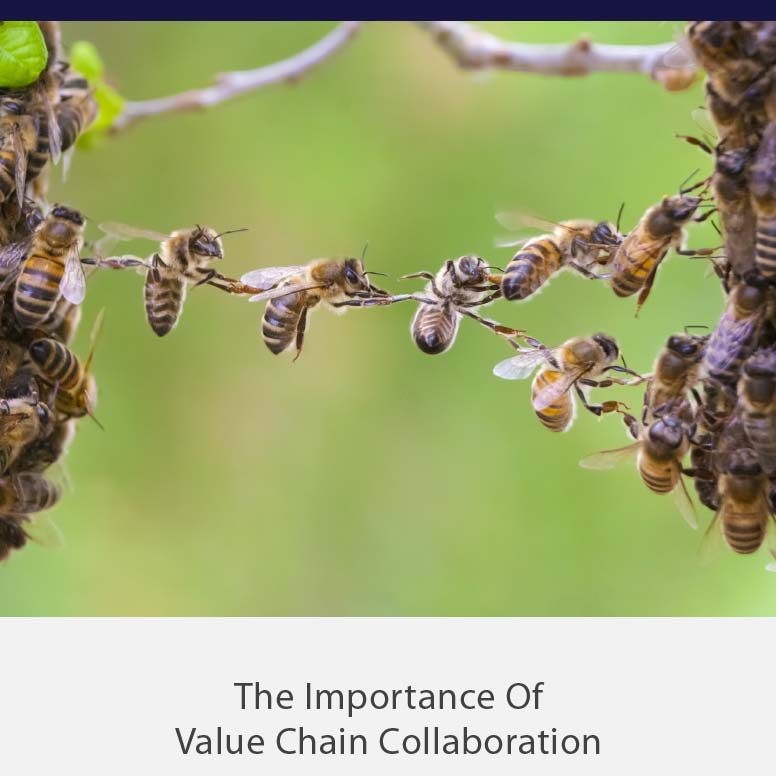
WAY #3: SET COMMON GOALS WHICH FOCUS ON WIN-WIN OUTCOMES & RESPONSIVENESS.
IN OUR LATEST INSIGHTS PIECE, WE EXPLORE THE THIRD WAY IN WHICH VALUE CHAIN COLLABORATION SUPPORTS THE VISIBILITY AND RESILIENCE OF THE VARIOUS SUPPLY CHAINS ORGANISATIONS DEPEND ON DAILY.
IN OUR LATEST INSIGHTS PIECE, WE EXPLORE THE THIRD WAY IN WHICH VALUE CHAIN COLLABORATION SUPPORTS THE VISIBILITY AND RESILIENCE OF THE VARIOUS SUPPLY CHAINS ORGANISATIONS DEPEND ON DAILY.
#3SET COMMON GOALS WHICH FOCUS ON
WIN-WIN OUTCOMES & RESPONSIVENESS.
#3 SET COMMON GOALS WHICH FOCUS ON WIN-WIN OUTCOMES & RESPONSIVENESS.
Collaboration becomes focused and constructive when parties agree on common objectives – such as appropriate product design as well as optimal production, distribution and raw material sourcing – to benefit the consumer and ultimately those partners involved.
As illustrated in Figure 1 below, value chain partners can achieve this by a joint understanding of the golden threads which expose win-win and hidden insights and opportunities across the chain. The collaboration process should be ongoing and based on facts and data, rather than the results of one-off projects or initiatives. It is built on trust and embedded in the culture of partner organisations.
Variety Options Primary Processing Waste Hotspots Procurement Data
TIER 2 SUPPLIER
Cost of Logistics Waste Hotspots Sourcing Regions Secondary Markets Procurement Data
TIER 1 SUPPLIER
Order Fill Data Recipe Configuration Production Efficiencies Product Costing Procurement Data
RETAILER / CONSUMER SERVICES
Sales Promotions Market Share Customer Complaints Store Waste Product Design
Figure 1
As per the illustrated example, as is often the case with market opportunities such as repositioning or launching specific national or private label brands, value chain partners will need to agree on the need to review and redesign a current product and category offering and target pricing to seize an opportunity in the market. It is key for partners to understand the value chain and cost dynamics of the current offering in order to identify and target selected opportunity spaces and the insights and data required to deliver on it.
In recent years, market conditions driven by consumer needs for a more cost-effective and quality-focused product offering have shifted the competitive landscape.
Actors across the value chain need to adapt their response to this fundamentally and it is evident that those who can collaborate effectively will be able to optimise the typically high transaction costs which exist in traditional buy-sell relationships.
A THREE-STEP PROCESS APPLIES IN THIS EXAMPLE:
Value chain visualisation and alignment of the priority of opportunities and risks to be jointly targeted.
Alignment of the insights required to deliver on them.
Prioritisation of the facts and data required to support those insights.
A THREE-STEP PROCESS APPLIES IN THIS EXAMPLE:
Value chain visualisation and alignment of the priority of opportunities and risks to be jointly targeted.
Alignment of the insights required to deliver on them.
Prioritisation of the facts and data required to support those insights.
IN OUR NEXT INSIGHTS PIECE, WE WILL TAKE A CLOSER LOOK AT WHY VALUE CHAIN PARTNERS NEED TO AIM FOR PRICE AND COST TRANSPARENCY TO ACHIEVE WIN-WIN OUTCOMES AND RESPONSIVENESS.
We use cookies on our website to give you the most relevant experience by remembering your preferences and repeat visits. By clicking “Accept All”, you consent to the use of ALL the cookies. However, you may visit "Cookie Settings" to provide a controlled consent. Click here to read our Privacy Policy.
This website uses cookies to improve your experience while you navigate through the website. Out of these, the cookies that are categorized as necessary are stored on your browser as they are essential for the working of basic functionalities of the website. We also use third-party cookies that help us analyze and understand how you use this website. These cookies will be stored in your browser only with your consent. You also have the option to opt-out of these cookies. But opting out of some of these cookies may affect your browsing experience.
Necessary cookies are absolutely essential for the website to function properly. These cookies ensure basic functionalities and security features of the website, anonymously.
Cookie
Duration
Description
cookielawinfo-checkbox-analytics
11 months
This cookie is set by GDPR Cookie Consent plugin. The cookie is used to store the user consent for the cookies in the category "Analytics".
cookielawinfo-checkbox-functional
11 months
The cookie is set by GDPR cookie consent to record the user consent for the cookies in the category "Functional".
cookielawinfo-checkbox-necessary
11 months
This cookie is set by GDPR Cookie Consent plugin. The cookies is used to store the user consent for the cookies in the category "Necessary".
cookielawinfo-checkbox-others
11 months
This cookie is set by GDPR Cookie Consent plugin. The cookie is used to store the user consent for the cookies in the category "Other.
cookielawinfo-checkbox-performance
11 months
This cookie is set by GDPR Cookie Consent plugin. The cookie is used to store the user consent for the cookies in the category "Performance".
viewed_cookie_policy
11 months
The cookie is set by the GDPR Cookie Consent plugin and is used to store whether or not user has consented to the use of cookies. It does not store any personal data.
Functional cookies help to perform certain functionalities like sharing the content of the website on social media platforms, collect feedbacks, and other third-party features.
Performance cookies are used to understand and analyze the key performance indexes of the website which helps in delivering a better user experience for the visitors.
Analytical cookies are used to understand how visitors interact with the website. These cookies help provide information on metrics the number of visitors, bounce rate, traffic source, etc.