DISRUPTIONS AFFECT EVERY PART OF GLOBAL AND LOCAL VALUE CHAINS IN THE CONSUMER GOODS DOMAIN TODAY, FROM RAW MATERIAL SOURCING TO THE END CONSUMER. AS A RESULT, THE RESILIENCE OF COMMERCIAL, OPERATIONAL AND FINANCIAL RELATIONSHIPS IS TESTED DAILY.
DISRUPTIONS AFFECT EVERY PART OF GLOBAL AND LOCAL VALUE CHAINS IN THE CONSUMER GOODS DOMAIN TODAY, FROM RAW MATERIAL SOURCING TO THE END CONSUMER. AS A RESULT, THE RESILIENCE OF COMMERCIAL, OPERATIONAL AND FINANCIAL RELATIONSHIPS IS TESTED DAILY.
The majority of business leaders have come to realise that the answer to improved resilience lies in understanding and investing in relationships and technical innovation outside of their organisational boundaries, in order to build on internal optimisation efforts.
Often, the challenge lies in where to start and what to focus on when it comes to value chain collaboration.There is a lack of visibility throughout extended value chains and often transactional engagement is limited to immediate buy-sell relationships. This exposes partners to disruption and variability without the ability to respond with the speed and agility required.
WE HAVE IDENTIFIED FIVE WAYS IN WHICH ORGANISATIONS CAN NAVIGATE THIS OPPORTUNITY.
Our observations are based on real experiences of what works and what does not. Our aim is to help organisations improve visibility and efficiency across their extended value chains. We aim to expand on these five ways in future Insights to follow.
UNDERSTAND HOW YOUR VALUE CHAIN WORKS, WHO IS INVOLVED AND WHY.
In order to do this, one needs to go beyond your immediate supplier relationships to understand the wider system dynamics such as key inputs into the value chain and the opportunities which intermediate product markets present.
In short, the goal is to map and understand all the ways in which value gets added – from base raw material to final product and consumer – to drive a common understanding of opportunities and risks between value chain partners.
ENCOURAGE OPEN AND STRONG COMMUNICATION WITH VALUE CHAIN PARTNERS.
To facilitate open communication, companies should focus on building a network of customers, partners and suppliers focused on fact-based communication and finding ways to draw insights from the same data. This, in turn, will help manage disruptions and support business continuity in a proactive manner.
SET COMMON GOALS WHICH FOCUS ON WIN-WIN OUTCOMES AND RESPONSIVENESS.
SET COMMON GOALS WHICH FOCUS ON WIN-WIN OUTCOMES AND RESPONSIVENESS.
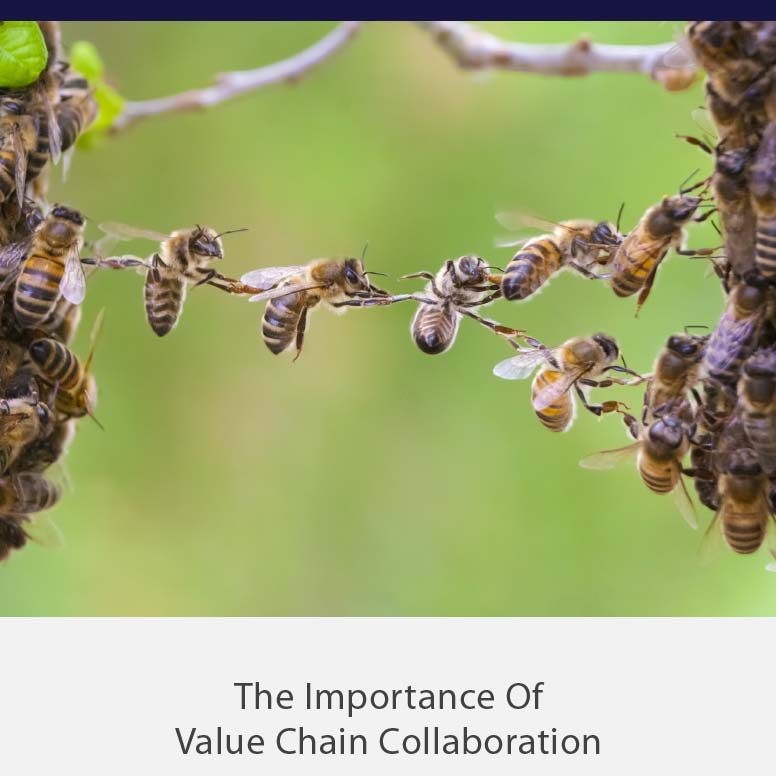
Typical customer-supplier relationships are based on protecting one’s own interests, often not seeing the wider perspective beyond one’s own organisation’s walls. Value chain collaboration requires a shift in these relationships into a more collaborative space.
Collaboration becomes focused and constructive when parties agree on common objectives, such as appropriate product design, optimal production, distribution and raw material sourcing, to benefit the consumer and ultimately those partners involved.
AIM FOR PRICE AND COST TRANSPARENCY.
Buying or procurement professionals are increasingly expected to understand the underlying cost drivers for their product categories, as opposed to negotiating a final price. This requires a deeper understanding of how cost and selling prices are built up.
While the final product cost is typically available, a detailed cost breakdown (in terms of the material component, wastage, conversion, labour and margin added) is not defined. Often, cost prices are not linked to the underlying commodity price and associated drivers, resulting in a lag between the cost price and underlying cost drivers.
LEVERAGE TECHNOLOGY AND VALUE CHAIN DATA TO DRIVE FACT-BASED COLLABORATION.
LEVERAGE TECHNOLOGY AND VALUE CHAIN DATA TO DRIVE FACT-BASED COLLABORATION.
The ability to adapt to digital operations and drive actionable improvements from data is vital. Using data to improve a value chain begins with taking full advantage of the data a company and its partners already hold and augmenting that with external reference data sets to drive the required insights.
When value chain partners share the same view of their reality in a proactive manner, it facilitates fact-based collaboration and a common focus on extracting the required insights and data.
VALUE CHAIN SOLUTIONS CAN SHOW YOU THE WAY.
WE CAN HELP YOU.
Cultivating a resilient supply chain puts organisations in a better position to anticipate, react to and plan for the unexpected. This enables cross-functional integration and collaboration with their ecosystem of vendors.
IN OUR NEXT INSIGHTS, WE WILL EXPLORE THE FIVE WAYS IN MORE DETAIL.
We use cookies on our website to give you the most relevant experience by remembering your preferences and repeat visits. By clicking “Accept All”, you consent to the use of ALL the cookies. However, you may visit "Cookie Settings" to provide a controlled consent. Click here to read our Privacy Policy.
This website uses cookies to improve your experience while you navigate through the website. Out of these, the cookies that are categorized as necessary are stored on your browser as they are essential for the working of basic functionalities of the website. We also use third-party cookies that help us analyze and understand how you use this website. These cookies will be stored in your browser only with your consent. You also have the option to opt-out of these cookies. But opting out of some of these cookies may affect your browsing experience.
Necessary cookies are absolutely essential for the website to function properly. These cookies ensure basic functionalities and security features of the website, anonymously.
Cookie
Duration
Description
cookielawinfo-checkbox-analytics
11 months
This cookie is set by GDPR Cookie Consent plugin. The cookie is used to store the user consent for the cookies in the category "Analytics".
cookielawinfo-checkbox-functional
11 months
The cookie is set by GDPR cookie consent to record the user consent for the cookies in the category "Functional".
cookielawinfo-checkbox-necessary
11 months
This cookie is set by GDPR Cookie Consent plugin. The cookies is used to store the user consent for the cookies in the category "Necessary".
cookielawinfo-checkbox-others
11 months
This cookie is set by GDPR Cookie Consent plugin. The cookie is used to store the user consent for the cookies in the category "Other.
cookielawinfo-checkbox-performance
11 months
This cookie is set by GDPR Cookie Consent plugin. The cookie is used to store the user consent for the cookies in the category "Performance".
viewed_cookie_policy
11 months
The cookie is set by the GDPR Cookie Consent plugin and is used to store whether or not user has consented to the use of cookies. It does not store any personal data.
Functional cookies help to perform certain functionalities like sharing the content of the website on social media platforms, collect feedbacks, and other third-party features.
Performance cookies are used to understand and analyze the key performance indexes of the website which helps in delivering a better user experience for the visitors.
Analytical cookies are used to understand how visitors interact with the website. These cookies help provide information on metrics the number of visitors, bounce rate, traffic source, etc.