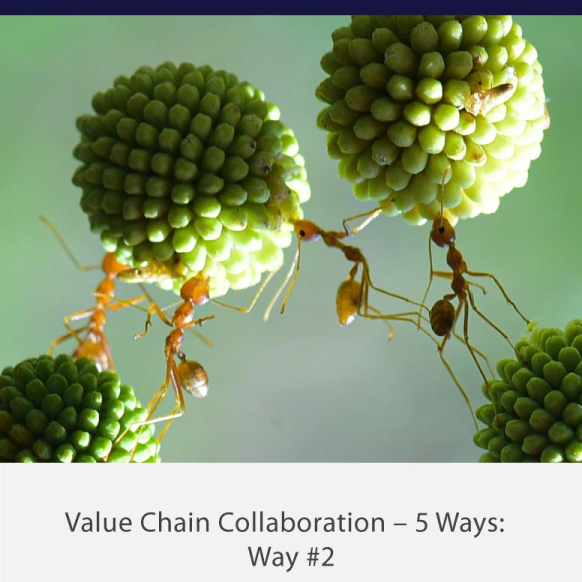
WAY #2: ENCOURAGE OPEN
& STRONG COMMUNICATION
WITH VALUE CHAIN PARTNERS.
WAY #2: ENCOURAGE OPEN & STRONG COMMUNICATION WITH VALUE CHAIN PARTNERS.
IN OUR LATEST INSIGHTS PIECE, WE EXPLORE THE SECOND WAY IN WHICH VALUE CHAIN COLLABORATION SUPPORTS THE VISIBILITY AND RESILIENCE OF THE VARIOUS SUPPLY CHAINS ORGANISATIONS DEPEND ON DAILY.
#2
ENCOURAGE OPEN & STRONG COMMUNICATION
WITH VALUE CHAIN PARTNERS.
#2
ENCOURAGE OPEN & STRONG COMMUNICATION WITH VALUE CHAIN PARTNERS.
To facilitate open communication
Companies should focus on building a network of customers, partners and suppliers focused on fact-based communication and finding ways to draw insights from the same data. This, in turn, will help build trust, manage disruptions and support business continuity in a proactive manner.
It is key to achieve a common understanding of how the value chain works and how specific outcomes are linked to each other. Most often, communication issues stem from differing perspectives and perceptions of issues. The common goal should and must be to avoid different versions of the truth as early on in the collaboration process as possible.
Traditional customer-supplier relationships are often focused on protecting their own interests first, without seeing the wider perspective and recognising the interdependence which exists in the value chain between partners.
HERE ARE SOME TIPS TO ESTABLISH OPEN & STRONG
COMMUNICATION BETWEEN VALUE CHAIN PARTNERS
HERE ARE SOME TIPS TO ESTABLISH OPEN & STRONG COMMUNICATION BETWEEN VALUE CHAIN PARTNERS
BE CLEAR REGARDING EXPECTATIONS, BOTH WAYS.
Assumption is the biggest enemy of transparent and open communication. While it is often convenient to do business on a handshake, it is key to formalise aspects such as service levels, quality standards and most importantly the expectations of the end consumer regarding product or service. Performance against expectations should be reviewed on a regular and honest basis to ensure speedy course correction if need be.
DEVELOP THE RELATIONSHIP BEYOND THE PURCHASE ORDER.
Emailing or sending that purchase order from an ERP system might be convenient but cannot replace the need for open and strong communication on a face-to-face or virtual basis. To support such communication, it is key to set up regular interfaces and to look at performance and data in a factual way, which all parties can understand and collaborate on.
AGREE ON COMMON OPPORTUNITY AREAS & FOLLOW UP ON THEM.
A powerful lever to improve trust and communication between value chain partners is being honest on performance versus expectations, sharing openly how services or products are performing. Openly sharing facts on market share, comparative cost and other related product data leads to a joint understanding and the willingness to explore alternative ways in which the value chain processes could work to drive improvement.
BE HONEST ABOUT JOINT RISKS & DEAL WITH THEM
PROACTIVELY.
The sum of parts is stronger than one when it comes to risk mitigation. Entities at different tiers can frequently see and anticipate risks but often find it difficult to act on them on their own. For example, a supplier at the raw material or commodity side of the value chain can understand price or supply risk trends but find it difficult or even impossible to translate this risk to partners further in the value chain, largely due to a lack of understanding of how such cost drivers might impact final product pricing. By jointly understanding these interdependencies, actions can often be taken before a risk impacts the entire value chain.
INVEST IN EACH OTHER’S SUCCESS, FOR THE LONGER TERM.
In today’s business environment which often rewards short-term results, this aspect often presents the biggest challenge to open and strong communication. By venturing beyond the transactional interface between customer and supplier and sharing longer term goals and key performance areas between value chain partners, new areas of opportunity open up. This requires a higher level of trust, but the rewards are significant for those who venture there.
CO-INVEST IN TOOLS WHICH PROVIDE VALUE CHAIN VISIBILITY & A COMMON VIEW OF DATA.
As illustrated in the points above, traditional use of tools and data is often focused within the organisation’s boundaries, with each value chain partner striving for optimisation and data protection within its control. While this is understandable, value chain partners often miss out on using the insights which come from this data to enable open and strong communication between partners. The secret to collaboration success is to share and focus on insights from such data, not the raw data itself.
IN OUR NEXT INSIGHTS PIECE, WE WILL TAKE A CLOSER LOOK AT HOW VALUE CHAIN PARTNERS CAN SET COMMON GOALS WHICH FOCUS ON WIN-WIN OUTCOMES AND RESPONSIVENESS.