THE VALUE CHAIN FOR COMMODITY RAW MATERIALS – from production and distribution to processors and retailers and the consumer – IS BY NATURE VOLATILE, UNCERTAIN, COMPLEX AND AMBIGUOUS.
THE NATURE AND SPEED OF CHANGE MEAN THAT THE OPERATING ENVIRONMENT IS UNPREDICTABLE, PUTTING CONSTANT PRESSURE ON MARGINS AS IS THE CASE CURRENTLY AND FOR THE FORESEEABLE FUTURE. THE INCREASING COMPLEXITY OF VALUE CHAINS WILL BE ONE OF THE MOST SIGNIFICANT CHALLENGES FOR BUSINESSES IN THE 21ST CENTURY. THE CURRENT AND FORECASTED PRICE LEVELS OF CONSUMER GOODS REPRESENT A PIVOTAL MOMENT FOR COMPANIES TO TAKE A HARD LOOK DEEP INTO THEIR VALUE CHAINS.
GLOBAL INFLATION
THE SOUTHERN AFRICAN MARKET FUNCTIONS WITHIN THE CONTEXT OF THE GLOBAL MARKETS AND THE MAJORITY OF COMMODITIES ARE LINKED TO THE PRICES OF SUCH GOODS ON INTERNATIONAL MARKETS. IT IS THEREFORE IMPORTANT TO NOTE THE CONTEXT DRIVING GLOBAL PRICES.
Furthermore, in South Africa, the monthly Household Affordability Index of the Pietermaritzburg Economic Justice and Dignity Group (PMBEJD) showed in January food prices increasing by 9% over the last 12 months, with a significant jump between December 2021 and January 2022.
DATA RELEASED BY STATISTICS SOUTH AFRICA ON 16 FEBRUARY 2022 SHOWS THAT CONSUMER FOOD PRICE INFLATION ACCELERATED TO 6.2% Y/Y IN JANUARY 2022, FROM 5.9% Y/Y IN THE PREVIOUS MONTH. FISH, OILS AND FATS AND VEGETABLES ARE THE PRIMARY PRODUCTS UNDERPINNING THIS UPTICK IN THE OVERALL CONSUMER FOOD PRICE INFLATION. – AGBIZ AGRIBUSINESS RESEARCH
THE CULPRIT
Ultra-high input cost inflation is to blame for the increase in the consumer price index (CPI). We have been experiencing this cycle for a while and unfortunately it is predicted to continue for the foreseeable future.
This reality is forcing market players such as food and beverage processors and retailers to make some very tough strategic choices with regards to pricing, protecting their volumes and retaining or growing their market share.
MAKING HARD DECISIONS
This ultra-high input cost inflation is not going away so hard questions have to be asked and swift decisions need to be made.
Which consumer segment do you play in? Can you, as so many others often do, pass on costs to the consumers and for how long? How will it impact profitability? Is this even possible from a market share point of view? And what about from an affordability perspective?
At the other end of this hazy decision-making tunnel is the consumer, particularly those in charge of purchasing decisions in their household. They have already been making hard decisions and trading down and will continue to do so which may start impacting you more severely if it has not already.
TAKING ACTION
As a retailer, processor or other market player in a food and beverage value chain, you will need to relook at and reposition your business and value chain, from a cost and efficiency point of view.
If you do not (or are unable to) relook at and reposition your business and value chain to accommodate consumers who need to trade down to lower priced offers, you may find yourself in a very difficult position.
WHERE TO START THE VIRTUOUS CYCLE
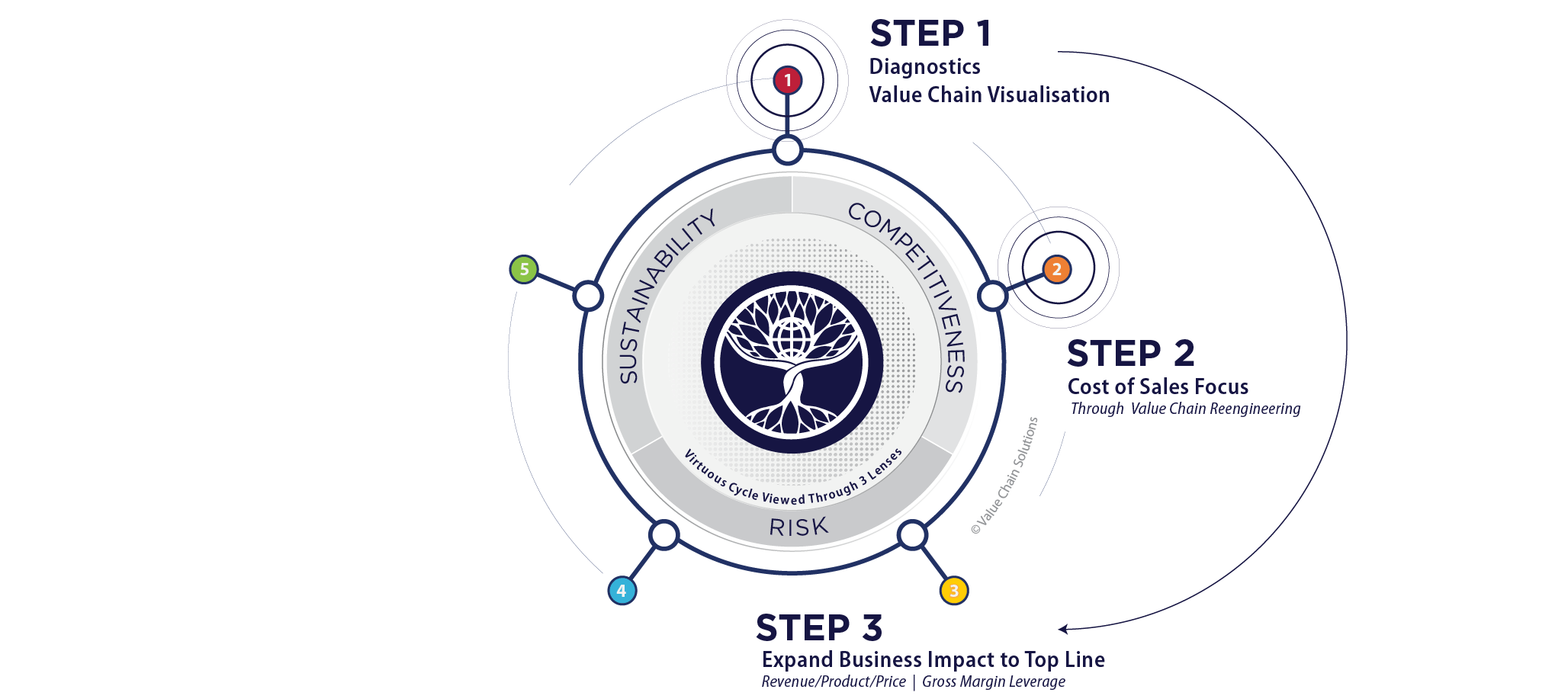
Our Virtuous Cycle is the key to unlocking opportunities and value in the value chain.
DIAGNOSTICS & VALUE CHAIN VISUALISATION
At a pivotal moment like this, it is critical to take a comprehensive look at what is happening in your value chain in order to ultimately unlock potential value for supply chain sustainability. To do this, one has to (a) visualise your extended value chain’s key dynamics and (b) diagnose the key relationships within this value chain.
At Value Chain Solutions, we focus on establishing the fact base using our unique approach and toolsets. The result is a complete view of the extended value chain including all the key inputs and relevant markets impacting the end-to-end supply chain in focus.
ONCE YOU HAVE COMPLETED THIS STEP, THE PINCH POINTS AND MAIN COST DRIVERS THAT ARE AFFECTED BY THE UNDERLYING INPUT COST INFLATION (IMPACTING INTERNATIONAL AS WELL AS LOCAL COMMODITIES) WILL BE REVEALED.
FOR EXAMPLE, IN SOUTH AFRICA, ALTHOUGH WE PRODUCE A WIDE VARIETY OF PRIMARY AGRICULTURAL PRODUCTS (FOR LOCAL CONSUMPTION AND EXPORT), WE STILL IMPORT MANY PROCESSED FOODS AND FINAL PRODUCTS TO MEET CONSUMER NEEDS. THE SIGNIFICANT INCREASES IN INPUT COSTS, HOWEVER, ARE NOW MORE EVIDENT THAN EVER IN THE PRICES WE PAY FOR THESE IMPORTED PRODUCTS.
ONCE DIAGNOSTICS AND VALUE CHAIN VISUALISATION HAVE BEEN COMPLETED, YOU CAN MOVE ON TO THE NEXT VIRTUOUS CYCLE STEP.
COST OF SALES FOCUS
The alarming input cost inflation is a perfect example of how the business environment changes continuously, rapidly and unexpectedly. At Value Chain Solutions we address this through a continuous rethink and reengineering of the cost base to protect and grow gross margin as well as market share.
ESSENTIALLY OUR FOCUS IS ON VALUE CHAIN REENGINEERING (AS OPPOSED TO COST CUTTING) TO DRIVE SUSTAINABLE PROFITABILITY, WHILST BALANCING RISK.
ONCE THIS PROCESS HAS BEEN COMPLETED, WE MOVE ON TO PART 3.
EXPANDING BUSINESS IMPACT TO THE TOP LINE
Once the value chain has been reengineered, tactical trade-off decisions can be made and extracted value chain efficiencies can be invested in the right place to ensure maximum impact where it matters.
FOR EXAMPLE, REPOSITIONING HOW YOU PRICE THINGS IN THE MARKET. THIS, IN TURN, WILL PROMOTE A COMPETITIVE VALUE CHAIN IF DONE OPTIMALLY.
CONCLUSION
If you follow Virtuous Cycle Steps 1 to 3, you should be in a better position to control the price you do, or do not, pass on to consumers and ultimately whether you are willing to risk the possible impact on market share and profitability or not.
Once you have a solution that works for you it can be scaled, leading to additional and continued smart investment in the value chain.
We use cookies on our website to give you the most relevant experience by remembering your preferences and repeat visits. By clicking “Accept All”, you consent to the use of ALL the cookies. However, you may visit "Cookie Settings" to provide a controlled consent. Click here to read our Privacy Policy.
This website uses cookies to improve your experience while you navigate through the website. Out of these, the cookies that are categorized as necessary are stored on your browser as they are essential for the working of basic functionalities of the website. We also use third-party cookies that help us analyze and understand how you use this website. These cookies will be stored in your browser only with your consent. You also have the option to opt-out of these cookies. But opting out of some of these cookies may affect your browsing experience.
Necessary cookies are absolutely essential for the website to function properly. These cookies ensure basic functionalities and security features of the website, anonymously.
Cookie
Duration
Description
cookielawinfo-checkbox-analytics
11 months
This cookie is set by GDPR Cookie Consent plugin. The cookie is used to store the user consent for the cookies in the category "Analytics".
cookielawinfo-checkbox-functional
11 months
The cookie is set by GDPR cookie consent to record the user consent for the cookies in the category "Functional".
cookielawinfo-checkbox-necessary
11 months
This cookie is set by GDPR Cookie Consent plugin. The cookies is used to store the user consent for the cookies in the category "Necessary".
cookielawinfo-checkbox-others
11 months
This cookie is set by GDPR Cookie Consent plugin. The cookie is used to store the user consent for the cookies in the category "Other.
cookielawinfo-checkbox-performance
11 months
This cookie is set by GDPR Cookie Consent plugin. The cookie is used to store the user consent for the cookies in the category "Performance".
viewed_cookie_policy
11 months
The cookie is set by the GDPR Cookie Consent plugin and is used to store whether or not user has consented to the use of cookies. It does not store any personal data.
Functional cookies help to perform certain functionalities like sharing the content of the website on social media platforms, collect feedbacks, and other third-party features.
Performance cookies are used to understand and analyze the key performance indexes of the website which helps in delivering a better user experience for the visitors.
Analytical cookies are used to understand how visitors interact with the website. These cookies help provide information on metrics the number of visitors, bounce rate, traffic source, etc.