UNLOCKING SOURCING & COLLABORATION POTENTIAL ACROSS THE EXTENDED VALUE CHAIN
THE MAJORITY OF FAST-MOVING CONSUMER GOODS COMPANIES ARE UNDER SUBSTANTIAL MARGIN PRESSURE DRIVEN BY WEAKER CONSUMER DEMAND AND EXTERNAL SHOCKS IMPACTING EXTENDED VALUE CHAINS.
ACHIEVING THE BALANCE BETWEEN COMPETITIVE CONSUMER PRICING AND THE NEED TO GROW VOLUMES AND PROTECT MARGINS IS NO EASY TASK. INCREASED VISIBILITY AND A BALANCED FOCUS ARE REQUIRED ON BOTH REVENUE AND COST OF SALES AS THE UNDERLYING DRIVERS.
LEVERAGING COST OF SALES OPPORTUNITIES REQUIRES INSIGHT INTO COST DRIVERS FROM SOURCE TO FINAL PRODUCT AND TRUE DATA-DRIVEN COLLABORATION WITH PARTNERS ACROSS THE VALUE CHAIN – A GOAL THAT CAN SEEM ELUSIVE AT TIMES.
THE VALUE CHAIN MATURITY MODEL OFFERS A ROADMAP AND APPROACH TO IMPROVE THE CAPABILITY OF ORGANISATIONS AND THEIR TRADING PARTNERS TO LEVERAGE OPPORTUNITIES THAT ALREADY EXIST IN THEIR WIDER VALUE CHAIN. THE DEGREE OF ORGANISATIONAL CHANGE REQUIRED TO LEVERAGE SUCH OPPORTUNITIES WILL DIFFER FROM ORGANISATION TO ORGANISATION, BUT SIGNIFICANT ADVANCES IN THE ABILITY TO STORE, PROCESS AND ANALYSE FRAGMENTED DATA CAN SUPPORT THE CHANGE EFFORT, IF DEPLOYED CORRECTLY.
THE VALUE CHAIN MATURITY MODEL
STAGE 1 REACTIVE
Decentralised Approach, Pockets of Nonintegrated Data
No Formal Value Capturing Process
Focused on Managing Cost Increases
STAGE 2 FUNCTIONAL FOCUS
More Centralised Approach, Relying on Transactional Data
Fragmented Value Capturing Process, Tools
Trading Partners Focused on Their Own Margins in Isolation of Each Other
STAGE 3 CROSS-FUNCTIONAL FOCUS
Supply Chain Focus Across an Organisation, Focusing on Specific Products
Coordinated Value Capturing Process, Tools, Working with Fragmented Data
Focused on Opportunities in Specific Supply Chains
STAGE 4 VALUE CHAIN FOCUS
Value Chain Focus Across an Organisation, Focusing on Scaling Opportunities Across Product Categories
Process to Extract Value within a Single Organisation is Supported by Structured Data and Insights
Focused on Wider Value Chain Understanding and Reengineering
STAGE 5 | CONNECTED VALUE CHAIN
Here, value extraction efforts are multiplied when partners across the value chain continuously see the same version of the truth and continually collaborate on opportunities. A collaborative approach enabled by digital transformation is required as well as the incentive to share data more openly between partners within the value chain.
As illustrated in the diagram below, value chain partners should be focused on golden data threads which can expose win-win and hidden insights and opportunities. The collaboration process should be ongoing and based on facts and data, rather than the result of one-off projects or initiatives. It is built on trust and embedded in the culture of partner organisations and value chain partners share specific data and incentives to collaborate.
Cost of Logistics Waste Hotspots Sourcing Regions Secondary Markets Procurement Data
TIER 1 SUPPLIER
Order Fill Data Recipe Configuration Production Efficiencies Product Costing Procurement Data
RETAILER
Sales Promotions Market Share Customer Complaints Store Waste New Product Design
A common view of insights is generated through shared data and facts between strategic partners.
Are you ready to uncover hidden potential for growth and efficiency between your organisation and your partners in the extended value chain?
THE OPPORTUNITY
Once strategic and transparent partnerships kickstart innovative and proactive interventions, a common view of opportunities within the extended value chain starts to emerge.
Technology allows us to decipher large, fragmented data sets in extended value chains and subsequently generate insights for a joint understanding of key elements that require collaborative action.
In addition, a Data- and Insights-driven Value Chain Can Also Improve Resilience Plans.
Existing and new data and focused use of technology can give value chain partners a wider perspective on risk management than what is possible within a single organisation. It starts with organising and sharing agreed value chain data between partners and augmenting that with external reference data sets to drive the required insights.
Opportunities to simplify product design as well as reduce waste, bottlenecks and overexposure to certain sourcing areas emerge from the connected value chain.
WHERE & HOW VALUE CHAIN SOLUTIONS CAN HELP
Regardless of where you find yourself in the value chain, we can help integrate fragmented data and drive various insights from it to facilitate ongoing optimisation and collaboration. Understanding and demystifying value chain dynamics from shelf to source is a key strength which we bring to our clients.
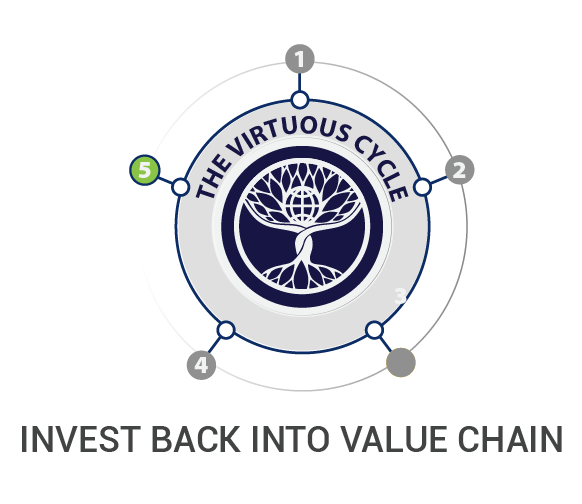
The key is to unlock the Virtuous Cycle of value chain optimisation to identify and resolve bottlenecks and unlock opportunities and value in the value chain.
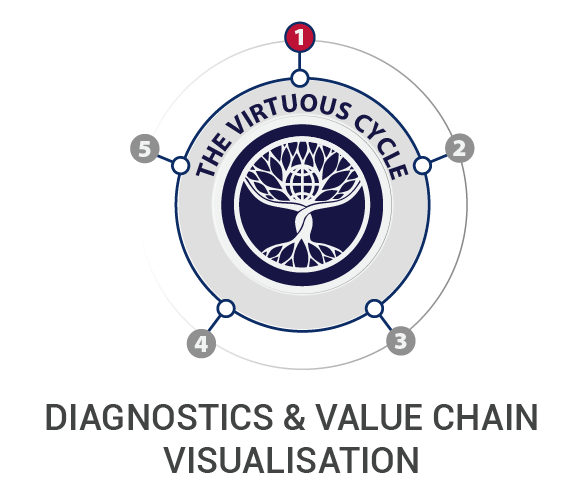
Visualisation of the extended value chain’s key dynamics and diagnostics of relationship are the first steps to create a common understanding of the value chain to support focused insights from fragmented relationships and unstructured data.
Visualisation of the extended value chain’s key dynamics and diagnostics of relationship are the first steps to create a common understanding of the value chain to support focused insights from fragmented relationships and unstructured data.
The key to fact-based value chain visualisation is to understand dynamics such as input cost drivers and intermediate market relationships beyond a particular supply chain in focus.
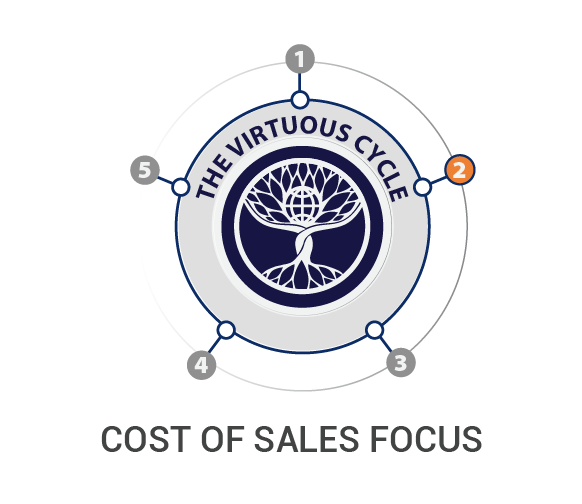
The value chain cost base requires a continuous rethink and reengineering. Our focus is on value chain reengineering, rather than cost cutting, to drive sustainable profitability – with value chain vulnerability and risk top of mind.
The value chain cost base requires a continuous rethink and reengineering. Our focus is on value chain reengineering, rather than cost cutting, to drive sustainable profitability – with value chain vulnerability and risk top of mind.
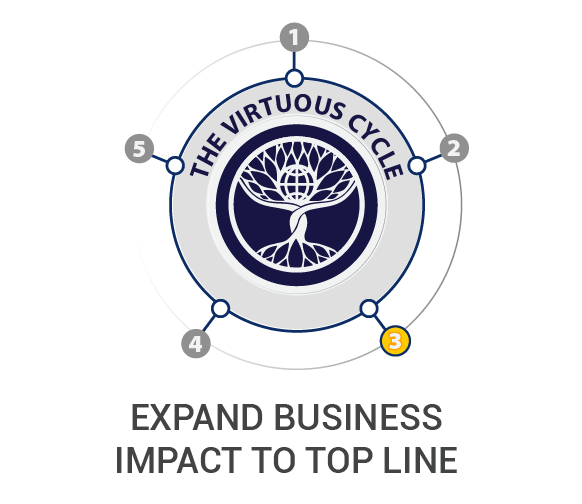
To ensure maximum impact where it matters, extracted value chain efficiencies need to be invested in the right place in a collaborative way. This, in turn, promotes a competitive and resilient value chain.
To ensure maximum impact where it matters, extracted value chain efficiencies need to be invested in the right place in a collaborative way. This, in turn, promotes a competitive and resilient value chain.
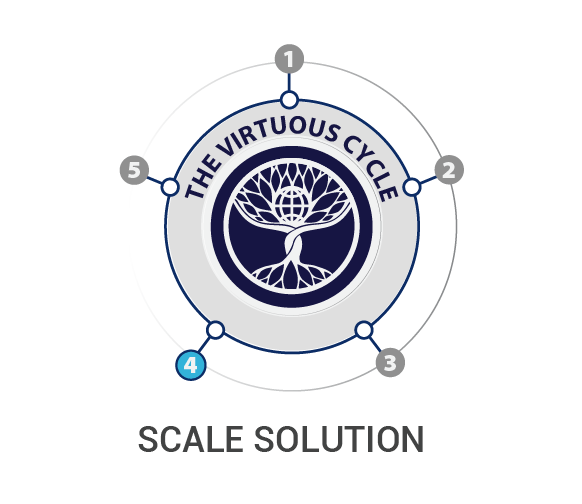
Our approach provides ongoing decision augmentation and value chain visibility. This ensures that collaborative opportunities can be scaled to multiply value benefits across product categories and business units.
Our approach provides ongoing decision augmentation and value chain visibility. This ensures that collaborative opportunities can be scaled to multiply value benefits across product categories and business units.
To leverage the power of the virtuous cycle, data-driven smart investment within the value chain is essential. This will set up the next round of reengineering and make a tangible difference.
To leverage the power of the virtuous cycle, data-driven smart investment within the value chain is essential. This will set up the next round of reengineering and make a tangible difference.
Are you ready to unlock opportunities and value in a connected value chain?
IN CLOSING
Through ongoing value chain collaboration with partners beyond your organisation, one can ensure more diverse resilience strategies. This unique approach, anchored in understanding the wider value chain dynamics, making sense of fragmented data and seeking transparency, makes for a connected value chain. One where win-win opportunities emerge in an expanded playing field. It requires a shift in the relationship of partner organisations, but the benefits to the consumer and such organisations outweigh the risks.
We use cookies on our website to give you the most relevant experience by remembering your preferences and repeat visits. By clicking “Accept All”, you consent to the use of ALL the cookies. However, you may visit "Cookie Settings" to provide a controlled consent. Click here to read our Privacy Policy.
This website uses cookies to improve your experience while you navigate through the website. Out of these, the cookies that are categorized as necessary are stored on your browser as they are essential for the working of basic functionalities of the website. We also use third-party cookies that help us analyze and understand how you use this website. These cookies will be stored in your browser only with your consent. You also have the option to opt-out of these cookies. But opting out of some of these cookies may affect your browsing experience.
Necessary cookies are absolutely essential for the website to function properly. These cookies ensure basic functionalities and security features of the website, anonymously.
Cookie
Duration
Description
cookielawinfo-checkbox-analytics
11 months
This cookie is set by GDPR Cookie Consent plugin. The cookie is used to store the user consent for the cookies in the category "Analytics".
cookielawinfo-checkbox-functional
11 months
The cookie is set by GDPR cookie consent to record the user consent for the cookies in the category "Functional".
cookielawinfo-checkbox-necessary
11 months
This cookie is set by GDPR Cookie Consent plugin. The cookies is used to store the user consent for the cookies in the category "Necessary".
cookielawinfo-checkbox-others
11 months
This cookie is set by GDPR Cookie Consent plugin. The cookie is used to store the user consent for the cookies in the category "Other.
cookielawinfo-checkbox-performance
11 months
This cookie is set by GDPR Cookie Consent plugin. The cookie is used to store the user consent for the cookies in the category "Performance".
viewed_cookie_policy
11 months
The cookie is set by the GDPR Cookie Consent plugin and is used to store whether or not user has consented to the use of cookies. It does not store any personal data.
Functional cookies help to perform certain functionalities like sharing the content of the website on social media platforms, collect feedbacks, and other third-party features.
Performance cookies are used to understand and analyze the key performance indexes of the website which helps in delivering a better user experience for the visitors.
Analytical cookies are used to understand how visitors interact with the website. These cookies help provide information on metrics the number of visitors, bounce rate, traffic source, etc.